
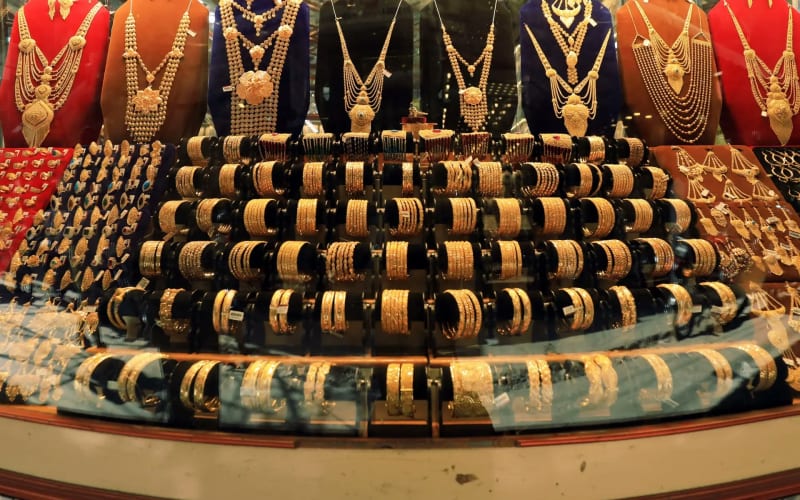
Quick answer: Check the day's rate from the All Pakistan Sarafa Gems & Jewellers Association (APSGJA) before you go: on 24 November 2026, 24-karat gold was Rs 385,436 per tola and 22-karat — the standard for jewellery — was Rs 353,316 per tola. Expect making charges of roughly 8% to 25% on top of the metal price, and remember Pakistan has no properly enforced hallmarking system, so a stamp alone is not proof of purity — ask for an electronic (XRF) purity test and get the karat, weight, rate and making charges written separately on the bill.
What is today's gold rate in Pakistan?
Gold rates are announced daily by the APSGJA, based on the international price and the rupee-dollar rate. The latest announced rates, for 24 November 2026, are:
| Purity | Price per tola | Price per 10 grams | Price per gram |
|---|---|---|---|
| 24K (99.9% pure) | Rs 385,436 | Rs 330,449 | Rs 33,045 |
| 22K (91.6% pure) | Rs 353,316 | Rs 303,000 approx. | Rs 30,300 approx. |
| 21K (87.5% pure) | Rs 337,257 | Rs 289,100 approx. | Rs 28,910 approx. |
| 18K (75% pure) | Rs 289,077 | Rs 247,800 approx. | Rs 24,780 approx. |
The 24K rate rose Rs 1,300 in a day (from Rs 384,136 on 23 November) and Rs 7,800 the day before — so never rely on yesterday's figure. The rate also moves during the day: on the morning of 25 November the Karachi sarafa board was showing around Rs 388,000 per tola, above the association's announced rate. Check the rate on the morning you buy.
How much gold is in a tola, masha and ratti?
Pakistan's sarafa market still uses the traditional weight system alongside grams, and knowing it stops the most common confusion at the counter:
- 1 tola = 11.6638 grams (jewellers usually round it to 11.66 g on the scale).
- 1 tola = 12 masha, and 1 masha = 8 ratti — so 1 tola is 96 ratti.
- 10 grams = 0.857 tola. If a shop quotes per 10 grams, divide by 10 and multiply by 11.6638 to compare with the per-tola rate.
Always have the piece weighed in front of you on a digital scale showing grams to two decimal places, and note the exact weight yourself.
Which karat should you buy: 24K, 22K or 21K?
- 24K (99.9% pure) is soft and bends easily, so it is used for bars and coins, not jewellery. For saving or investment, buy a certified 24K bar or coin — no making charges at all.
- 22K (91.6% pure) is the standard for jewellery in Pakistan. Alloy is mixed in so the piece holds its shape and survives daily wear. Most bangles, necklaces and bridal sets are 22K.
- 21K (87.5% pure) is also common for traditional sets, slightly cheaper than 22K.
- 18K (75% pure) is used for lighter, delicate designs and diamond-set pieces.
The rule is simple: jewellery for wearing, 22K or 21K; gold for saving, a 24K bar or coin. Buying jewellery as an investment is the most expensive mistake — you lose the making charges the moment you walk out of the shop.
What are making charges and wastage?
The metal price is only part of what you pay for jewellery. Two extra charges are added, and both are negotiable:
- Making charges (ujrat / mazdoori) — the labour cost of crafting the piece. Typically 8% to 25% of the gold value depending on the design: plain bangles at the low end, intricate bridal work at the high end. Some shops quote per gram instead (roughly Rs 800 to Rs 2,500 per gram). Always ask for the figure in rupees, in writing, before the piece is weighed.
- Wastage — a percentage some jewellers charge for gold supposedly lost during making. The same wastage is deducted again when you sell the piece back, so ask about it up front and ask what the shop will deduct on buy-back.
Work out the total yourself before paying: net gold weight × today's rate per gram for your karat + making charges. If the shop's total is far above your calculation, ask them to show the working — a reputable jeweller will.
How to check gold purity and hallmarks in Pakistan
This is the part most buyers skip, and it matters most. Pakistan's hallmarking system exists on paper but barely works in practice: the Pakistan Standards and Quality Control Authority (PSQCA) set standard PS:2797 and hallmarking has been mandated since 2021 for items above 2 grams, but there are only two government assaying centres in the whole country (Karachi and Lahore), enforcement is weak, and the Competition Commission's November 2025 study found about 90% of gold trade happens through informal channels. In plain terms: a stamp is the jeweller's own mark, not a government guarantee. Do this instead:
- Look for the fineness stamp on the piece: 999 means 24K, 916 means 22K, 875 means 21K, 750 means 18K and 585 means 14K. Treat it as a starting point, not proof — fake stamps exist.
- Ask for an XRF test. Reputable sarafa shops and branded jewellers test purity on the spot with an electronic karat tester (XRF machine). If a shop refuses to test in front of you, walk away.
- Check the stones separately. For stone-set pieces, ask for gross weight, stone weight and net gold weight as three separate figures. Stones must never be charged at the gold rate.
- Check the clasps, hooks and screws — they take the most wear, especially on necklaces and jhumkas — and ask whether a hollow-looking design is hollow, since hollow work dents easily.
- Visit two or three shops for the same design and compare the full written quote, not just the headline rate.
What must the bill show?
Never leave a gold shop without a proper stamped cash memo — it is the only thing that protects you when you sell, exchange or dispute the piece later. The bill must list, as separate lines: the shop's name, address, phone and stamp; the karat and fineness (for example, 22K / 916); gross weight, stone weight and net gold weight; the rate per tola used that day; making charges and wastage, in rupees; and the buy-back policy, including how much "kaat" the shop will deduct if you sell it back.
Keep the bill safe — with the piece, not in a drawer you will forget. On resale, a jeweller pays only the metal value at that day's rate: making charges are not returned, and the kaat deduction applies. Exchange (swapping old gold for new) usually gets better terms than a cash sale, so ask both prices before deciding.
Buying gold for a wedding or as savings: a quick checklist
- Check the day's APSGJA rate on the morning you buy, and confirm the shop is using a rate close to it.
- Decide the karat first — 22K or 21K for wearing, 24K bars or coins for saving.
- Set your budget in tola, not only in rupees, so a rate rise does not quietly shrink what you get.
- Ask for the XRF purity test and the net gold weight, in writing.
- Get making charges and wastage in rupees on the bill — never accept a verbal figure.
- Ask the buy-back kaat before you pay, not when you need the money.
- Do not panic-buy during a price spike — gold often jumps on bad news, and buying at a peak costs more than waiting a few days.
Related guides
If you are buying gold with money sent from abroad, read how to send money to Pakistan from abroad: Roshan Digital Account and remittance options — a bank transfer through official channels is safer and cheaper than carrying cash. For the paperwork side of a large purchase, see how to file your income tax return in Pakistan on FBR IRIS. You can also browse gold and jewellery sellers in the Shopping & Retail Chains category on PkBizGuide.
Frequently asked questions
What is the gold rate in Pakistan today?
On 24 November 2026 the APSGJA rate was Rs 385,436 per tola for 24K gold, Rs 353,316 for 22K, Rs 337,257 for 21K and Rs 289,077 for 18K. Rates change daily and move during the day, so confirm the current rate on the morning you buy.
How many grams are in one tola of gold?
One tola is 11.6638 grams (usually rounded to 11.66 g). One tola is 12 masha, one masha is 8 ratti, and 10 grams is 0.857 tola.
Which karat of gold is best to buy in Pakistan?
For jewellery, 22K (91.6% pure) is the standard — strong enough for daily wear. For saving or investment, buy a certified 24K bar or coin, which carries no making charges.
How much are making charges on gold jewellery in Pakistan?
Typically 8% to 25% of the gold value, depending on the design — plain bangles at the low end, intricate bridal work at the high end. Always get the figure in rupees, in writing, before you pay.
How can I check if gold is real in Pakistan?
Look for the fineness stamp (916 for 22K, 999 for 24K), but do not rely on it alone — hallmarking is barely enforced and fake stamps exist. Ask the shop to test the piece in front of you with an electronic XRF karat tester, and get the karat, weight and rate written on a stamped bill.
Do I get making charges back when I sell my gold?
No. On resale a jeweller pays only the metal value at that day's rate, minus a "kaat" (wastage) deduction. Making charges are never returned, which is why jewellery is a poor investment and bars or coins are better for saving.
Facts checked on 25 November 2026 against the All Pakistan Sarafa Gems & Jewellers Association rates of 24 November 2026 as reported by Business Recorder, MM News and Abb Takk, and hallmarking guidance from PSQCA standard PS:2797 and the Competition Commission of Pakistan's November 2025 gold-market study. Gold rates change daily — confirm the current rate with your jeweller before you buy. This guide explains how gold buying works in Pakistan; it is general information, not financial advice.
Explore more businesses in Shopping & Retail Chains
Browse more verified listings in this category to compare services and contact top providers.
Explore CategoryRelated Blogs
Continue reading related guides to deepen topic relevance.
How to Pay Your Water Bill Online in Pakistan: WASA, KWSB and Other Utilities
Pay your water bill online in Pakistan without visiting an office: check your WASA or KWSC bill with the number on an old bill, then pay through ePay Punjab, JazzCash, Easypaisa or your bank app. City-by-city portals, steps and fixes.
How to Receive Freelance Payments in Pakistan: Bank Accounts, Payoneer and Wise
Get paid for freelance work in Pakistan the right way: Payoneer fees and steps, Wise transfers to your bank, the SBP freelancer account that lets you keep dollars, and the 0.25% tax on IT export income.
How to Choose a School in Lahore: Admissions, Fees and What to Check Before Enrolling
Choosing a school in Lahore? Admission season, fee ranges, the 5% fee-increase cap, BISE Lahore affiliation checks, documents and a visit checklist — everything parents need before enrolling.